
£24.99 – £49.99Price range: £24.99 through £49.99
For research use only — Not for human or animal use
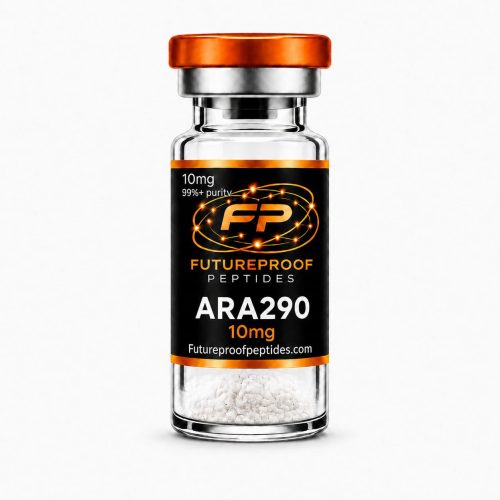
Our ARA-290 10 mg vial contains ARA-290 (cibinetide), an EPO-derived research peptide investigated for its interaction with the innate repair receptor (IRR). It has attracted scientific interest because researchers have explored pathways associated with inflammation, cellular stress and tissue protection without the same red blood cell-producing activity normally associated with erythropoietin.
ARA-290 is an 11-amino acid peptide based on a specific region of the erythropoietin molecule. This relatively targeted mechanism has led to laboratory research and clinical studies examining inflammatory signalling, nerve-related conditions and tissue repair.
ARA-290, also known as cibinetide, is a synthetic peptide derived from erythropoietin (EPO). EPO is best known as a hormone involved in controlling red blood cell production, but researchers discovered that parts of the molecule are also associated with separate pathways involved in cellular protection and repair.
ARA-290 was developed to investigate these protective pathways without substantially stimulating erythropoiesis — the process through which new red blood cells are produced.
This distinction is central to ARA-290 research. Rather than studying the conventional blood-forming activity of EPO, scientists can examine signalling associated with cellular injury, inflammation and recovery.
Much of the scientific interest surrounding ARA-290 relates to the innate repair receptor (IRR). This receptor complex is associated with the body’s response to cellular stress and tissue damage.
ARA-290 has been investigated as an IRR agonist, meaning researchers study its ability to activate signalling through this receptor. Experimental work has associated IRR activation with changes in inflammatory signalling and mechanisms involved in protecting stressed tissue.
The distinction between the IRR and the classical EPO receptor also helps explain why an EPO-derived compound can be investigated without primarily focusing on increased red blood cell production.
ARA-290 research has moved beyond basic laboratory models into human clinical studies. One area receiving particular attention has been small-fibre neuropathy, a condition involving damage to small sensory nerve fibres.
Clinical research involving people with sarcoidosis-associated small-fibre neuropathy has investigated outcomes including neuropathic symptoms, pain and measures of small nerve fibre structure.
Other experimental research has examined ARA-290 in models involving metabolic disease, inflammatory responses and tissue injury. These different areas stem from interest in the IRR rather than from the blood-forming properties of erythropoietin.
Findings from experimental and clinical studies have generated interest in several potential effects of ARA-290.
These areas should not be interpreted as established therapeutic benefits. ARA-290 remains a research compound, and findings from individual laboratory or clinical studies do not establish effectiveness for general medical use.
Although ARA-290 is EPO-derived, it should not be confused with erythropoietin itself.
Conventional EPO signalling is strongly associated with erythropoiesis and therefore red blood cell production. ARA-290 was designed around a different part of EPO biology, allowing researchers to investigate tissue-protective receptor signalling while minimising conventional erythropoietic activity.
This separation between haematopoietic and tissue-response pathways is one of the features that has made ARA-290 cibinetide scientifically interesting.
Clinical studies have monitored the safety and tolerability of cibinetide alongside the outcomes being investigated. Reported side effects and safety findings vary according to the population, protocol and duration of each study.
Longer-term safety and effectiveness for unapproved applications have not been established. Results from controlled studies should therefore be interpreted within the specific conditions and populations in which they were obtained.
Our ARA-290 10mg vial is supplied for laboratory research and should be handled using appropriate research procedures. Storage conditions should remain stable throughout the observation period, with the material protected from excessive heat, moisture and direct light.
Any reference to day dispatch relates solely to order fulfilment and does not affect the compound’s research characteristics or specification.
Disclaimer: This product is supplied strictly for laboratory research purposes only. Not for human or animal consumption.
| Specification | Details |
|---|---|
| Product | ARA-290 10mg Vial |
| Alternative Name | Cibinetide |
| Active Compound | ARA-290 |
| Total Content | 10mg per vial |
| Compound Type | Synthetic EPO-derived peptide |
| Peptide Length | 11 amino acids |
| Parent Molecule | Erythropoietin (EPO) |
| Primary Research Target | Innate Repair Receptor (IRR) |
| Research Focus | IRR signalling, inflammatory response, tissue protection and nerve-related research |
| Erythropoietic Activity | Designed to investigate EPO-associated tissue-protective signalling without substantial red blood cell-producing activity |
| Form | Dry peptide powder |
| Appearance | White to off-white powder |
| Storage | Store under controlled refrigerated conditions according to the supplied product specification |
| Handling | For controlled laboratory handling only |
| Intended Use | Laboratory research purposes only |
| Restriction | Not for human or animal consumption |
Discount Applied Successfully!
Your savings have been added to the cart.
Added to cart
Check out our shop to see what's available