
£29.99 – £54.99Price range: £29.99 through £54.99
For research use only — Not for human or animal use
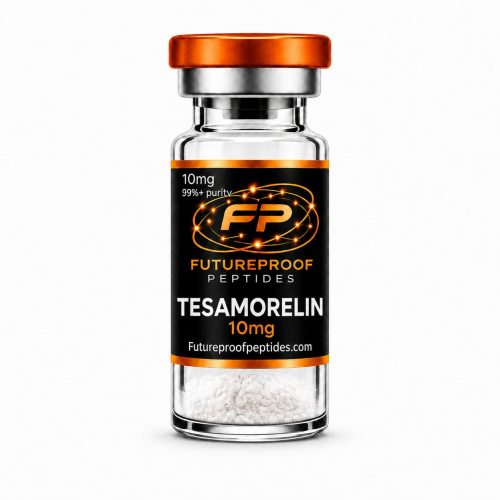
Our Tesamorelin 5mg Vial contains a synthetic analogue of growth hormone-releasing hormone (GHRH). It is studied for the way it interacts with the body’s natural growth hormone pathway, particularly signalling between the hypothalamus and pituitary gland.
Rather than supplying growth hormone directly, tesamorelin mimics GHRH signalling. This has made it an established subject of endocrine and metabolic research, with published clinical studies examining visceral abdominal fat, IGF-1, lipid metabolism and body composition.
Our 5mg vial is intended strictly for laboratory research and controlled analytical work.
Tesamorelin is a synthetic GHRH analogue. GHRH is a naturally occurring hormone produced by the hypothalamus that signals the pituitary gland to release growth hormone.
Tesamorelin therefore acts further upstream in the endocrine pathway than administering growth hormone itself. Activation of GHRH receptors on pituitary cells encourages pulsatile growth hormone secretion, which can subsequently influence circulating insulin-like growth factor 1 (IGF-1).
This mechanism is important because it gives researchers a way of studying the body’s own growth hormone-releasing system rather than introducing exogenous growth hormone directly.
Tesamorelin has attracted particular attention because of clinical research into visceral adipose tissue — the fat stored deeper within the abdomen around internal organs.
One major randomised study followed 412 adults with HIV and abdominal fat accumulation for 26 weeks. Visceral adipose tissue decreased by 15.2% in the tesamorelin group, compared with a 5.0% increase in the placebo group. The study also recorded a reduction in triglycerides and an increase in IGF-1.
Importantly, this research concerned a specific clinical population with HIV-associated abdominal fat accumulation. The results should not be interpreted as evidence for general weight loss or fat-loss use.
Further studies have examined areas including liver fat, lipid metabolism, glucose regulation and the relationship between changes in visceral fat and wider metabolic markers.
The most established findings surrounding tesamorelin concern changes in visceral rather than general subcutaneous fat.
Published research has reported:
A separate six-month randomised trial involving 50 adults with HIV and abdominal fat accumulation found a significant reduction in both visceral adipose tissue and liver fat compared with placebo.
This distinction between visceral and subcutaneous fat is useful when interpreting the research. Tesamorelin studies have not simply examined changes around the visible stomach area; researchers have used methods such as CT and MRI to measure internal abdominal fat compartments.
The pituitary connection is also important when reviewing tesamorelin research. Since the compound relies on an intact hypothalamic-pituitary growth hormone axis, disruption to this system can materially affect its pharmacological action.
For example, prescribing information for approved tesamorelin medicines lists disruption of the hypothalamic-pituitary axis — including that caused by a pituitary gland tumour, pituitary surgery, head irradiation or head trauma — as a contraindication.
Clinical research has also monitored IGF-1 because stimulating endogenous growth hormone can raise circulating IGF-1 concentrations. These endocrine effects are an important part of tesamorelin’s research profile rather than simply a secondary observation.
Tesamorelin 5mg Vial is supplied for research purposes and should be handled according to the storage, stability and preparation requirements applicable to the specific formulation.
Reconstituted solutions can have different stability requirements depending on formulation and diluent. Researchers should therefore follow the supplied product specification rather than assuming that instructions for a licensed tesamorelin medicine apply to a separate research formulation.
Published clinical protocols have involved subcutaneous administration using a needle and syringe, with approved-product instructions referring to rotating sites within the abdomen. References to the stomach area or belly button in clinical literature describe administration-site protocols and should not be treated as instructions for this research product.
Keep the vial protected from excessive heat, moisture and direct light and follow the stated storage conditions throughout the research period.
Disclaimer: This product is intended strictly for laboratory research. It is not intended for administration to humans or animals.
| Specification | Details |
|---|---|
| Product | Tesamorelin 5mg Vial |
| Active Ingredient | Tesamorelin |
| Total Content | 5mg per vial |
| Compound Type | Synthetic analogue of growth hormone-releasing hormone (GHRH) |
| Form | Lyophilised peptide powder |
| Appearance | White to off-white powder |
| Purity | High purity research formulation |
| Biological Target | GHRH receptor |
| Primary Pathway | Pituitary growth hormone release and downstream IGF-1 signalling |
| Research Areas | Visceral adipose tissue, endocrine signalling, body composition, lipid metabolism, and hepatic fat research |
| Storage | Store refrigerated at 2-8°C unless otherwise stated on the product specification |
| Reconstitution | Required prior to laboratory use |
| Reconstituted Solutions | Follow formulation-specific stability and storage requirements |
| Handling | Use under standard laboratory conditions |
| Intended Use | Strictly for laboratory research |
| Restriction | Not intended for administration to humans or animals |
Discount Applied Successfully!
Your savings have been added to the cart.
Added to cart
Check out our shop to see what's available